
“On a scale of 1 to 10, how would you rate your pain?”
We’ve all been asked that question, and almost none of us feel confident with our answer. If a number can’t capture a headache or a backache, how could a survey capture what it’s like to change how your body processes hunger?
That gap between what people feel and what they can say is one of the biggest blind spots in consumer research. And while it impacts how consumers shop across every category, it’s especially relevant in health and wellness, where GLP-1s are changing how people experience their bodies.
The fix is to stop relying on words and numbers alone. VF’s QualLab team uses body mapping, an arts-based technique that lets people show what they can’t say. With GLP-1 users, it surfaced what direct questions missed, including symptoms they’d never told their own doctors.
Why is it so hard for people to describe how they feel?
When we don’t feel well or are in pain, our vocabulary shrinks to “off,” “weird,” or “not quite right.” Physical and emotional experiences live in the body, not in sentences, so asking people to rate or explain them captures only the part they can already put into words.
Surveys, social listening, and AI-driven tools are built to analyze what people say, but they can’t capture what people haven’t yet found the words for.
Arts-based methods can close that gap. When people answer a direct question, they edit and give the tidy, explainable version. But, when they create something, they bypass that filter and reach feelings they couldn’t otherwise put into words. It’s the difference between asking “What symptoms did you have?” and giving someone the space to discover the answer.
What is body mapping in qualitative research?
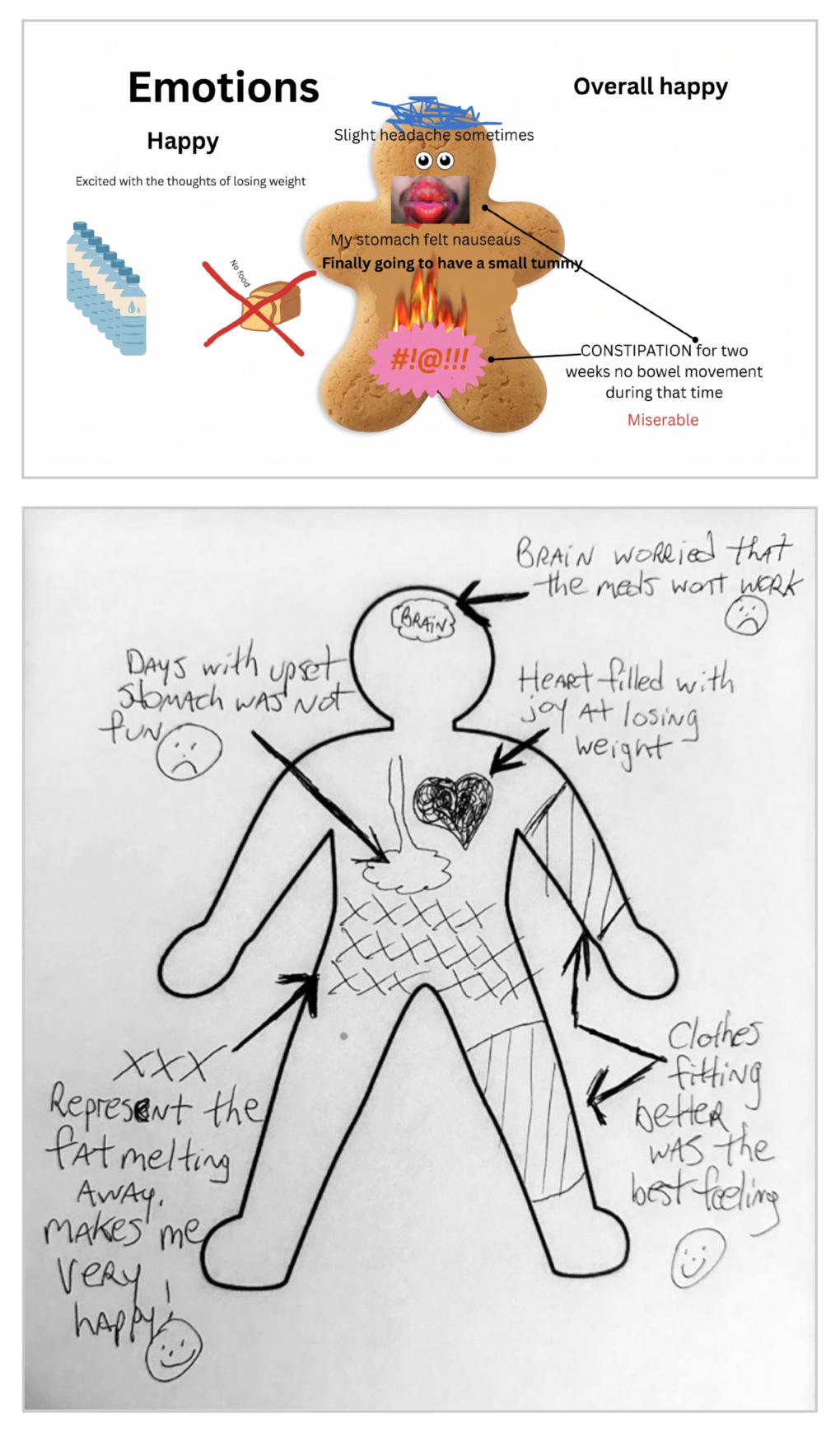
Body mapping is a qualitative research technique where participants mark their physical sensations, symptoms, and emotions onto an outline of the human body. They use color, symbols, words, and images to show where they feel something and what it feels like. A moderator then explores the map with them to uncover meaning, context, and connections.
Body mapping is part of the QualLab Artifact Toolkit, a set of techniques drawn from arts-based methods, psychology, and the social sciences. The toolkit sits within our Creative pillar and is designed for topics where people struggle to articulate their feelings.
A typical body mapping exercise works in three steps:
- Create. Participants build their map, by hand with art supplies or with digital tools.
- Reflect. The act of creating prompts memories, details, and feelings participants hadn’t consciously considered.
- Unpack. Moderator and participant explore the map together to understand what each mark, color, and placement means.
No artistic skill is required, and nothing is judged on how it looks. The value is in what the process brings to the surface.
What did body mapping reveal about the GLP-1 experience?
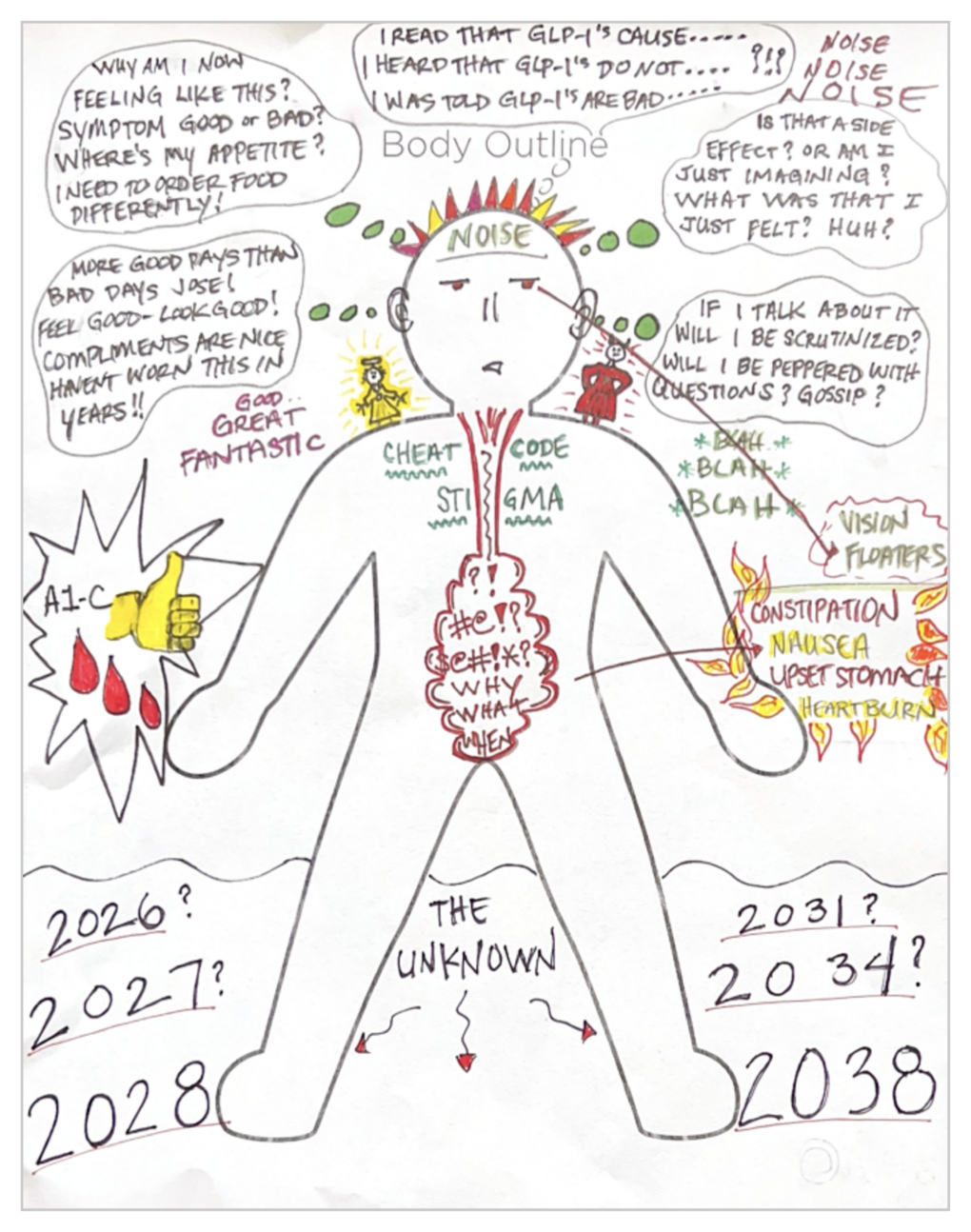
Body mapping uncovered a far fuller picture of the GLP-1 experience than direct questions could. Participants surfaced physical and emotional experiences side by side, and many shared symptoms they had never mentioned to their own doctors.
How we ran it. We recruited people currently using or considering a GLP-1. Participants completed their body maps as a homework activity before virtual in-depth interviews (IDIs). They could create them by hand or digitally. Working on their own time gave them space to reflect privately on a deeply personal topic.
What it surfaced:
- The physical and the emotional, together. Participants mapped how their bodies felt alongside how they felt about their bodies, from excitement to anxiety.
- The expected and the unexpected. GI symptoms showed up, as anticipated. So did experiences participants said they wouldn’t have raised if simply asked, such as brain fog, dry mouth, headaches, and a “shivery” cold feeling.
“There’s lots of things I didn’t bring up. Like when I’m getting shivery and cold…but I didn’t feel like that’s something to complain to your doctor about because what could they do about it?” —Participant
- Shame and stigma. The private, self-paced format gave participants a safe way to express feelings that were complex and uncomfortable to say out loud.
The standout finding: many participants reported symptoms they had never told their doctors. Body mapping gave them a private, low-pressure way to surface experiences that never came up in a medical setting.
Why hands-on creation matters: The physical act of making something triggered memories and sparked detail. It helped participants surface deeply embodied feelings and put them into words.
What should brands take away from this?
The experiences people struggle to articulate are often the ones driving their decisions. Whether someone stays on a treatment, recommends it, or quietly stops can hinge on feelings they’ve never said out loud, sometimes not even to their doctor.
For brands in health, pharma, wellness, and adjacent categories, that has direct implications for:
- Messaging that reflects how people actually feel, not just how they describe it
- Patient and customer support that addresses unspoken concerns, including stigma
- Product and experience design informed by the full physical and emotional journey
- Persistence and loyalty, by understanding the moments that lead people to drop off
Quantitative data tells you what is happening. Body mapping helps explain what it feels like, and why it matters.
Get past the 1-to-10 scale
If your consumers can’t fully explain how they feel, a better rating scale won’t fix it. And that challenge isn’t unique to health.
Body mapping and the rest of QualLab’s Artifact Toolkit work in any category where experiences are felt before they’re explained:
- Food and beverage: cravings, indulgence, guilt, and how GLP-1s are changing the way people eat and snack
- Beauty and personal care: confidence, self-image, and how a product makes someone feel in their own skin
- Financial services: the stress, relief, and anxiety tied to money decisions
- Fitness and wellness: motivation, burnout, and how routines actually feel day to day
- Retail and customer experience: the frustration or delight in moments people rarely stop to describe
Wherever emotion drives the decision, there’s an unspoken story behind it. Our moderators know how to bring it to the surface.


